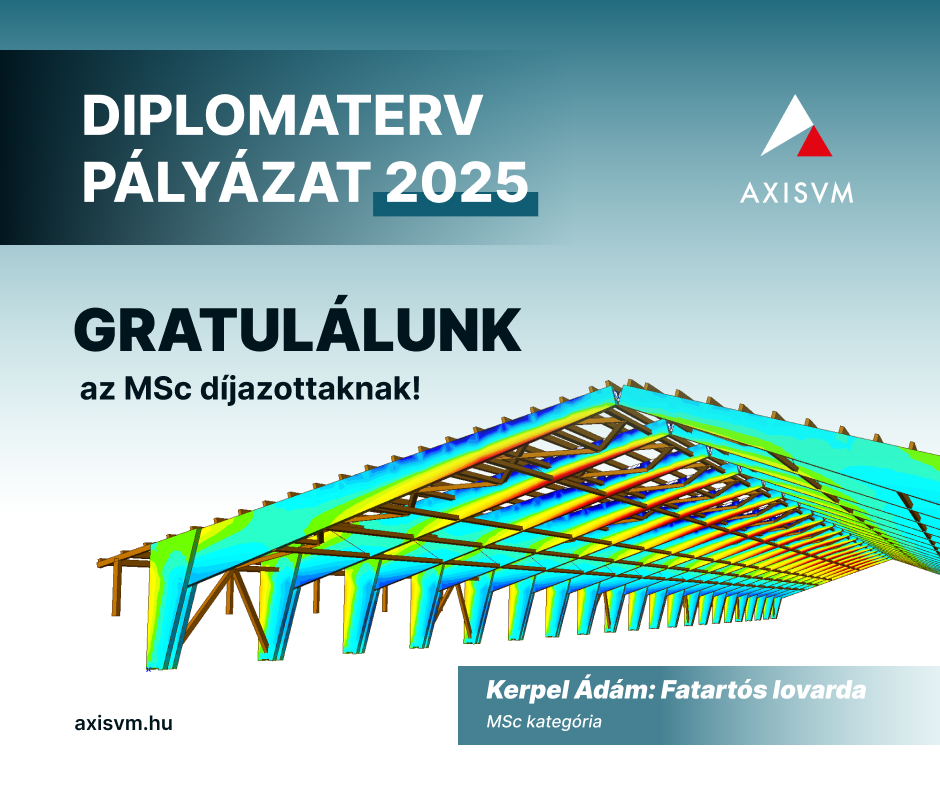
Diploma Thesis Program 2025: Ádám Kerpel
Interview about the structural analysis of a glued laminated timber riding hall

Interview about the structural analysis of a glued laminated timber riding hall
1. What was the topic of your diploma thesis, and which main engineering issues did it address?
My thesis focused on a riding hall constructed from glued laminated timber (glulam) beams, with a span of nearly 45.00 m. The structural system was designed as a three-hinged frame, with particular emphasis on its three main joints. Special attention was given to the frame corner, which was designed as a bolted ring connection consisting of three concentric circles.
2. Was there any detail that required particular engineering creativity? If so, which one?
Engineering creativity was primarily required due to the material properties inherent to timber structures. Timber, as an orthotropic material, presented specific challenges in this respect. Accommodating the internal forces arising in the structure demanded creative solutions at each joint.
3. What were the greatest professional challenges during the design process?
One of the greatest professional challenges was the frame corner formed with a bolted ring connection. The difficulty lay in the fact that the grain directions of the column and beam elements differ, which significantly affects the load-bearing capacity of the bolted connection. The situation was further complicated by the fact that each bolt was subjected to forces acting in different directions due to the internal force distribution.
4. How did you approach these problems, and what solutions did you find?
I initially addressed the bolted ring issue by analyzing sub-models before integrating the solution into the global three-dimensional shell model. For modeling the forces acting in the bolts, I considered the Node-to-Node link element to be the most appropriate solution. However, I believe it is essential to verify uncertain solutions using simplified sub-models that can be easily checked by hand.
5. Which AXISVM functionalities and modules did you use during your diploma project?
In addition to the basic functionalities, I used the SE1 module (Modal Response Spectrum Analysis) and the vibration analysis. These were essential for analyzing the force behavior of the bracing system, particularly for horizontal actions other than wind loads.
6. Was there any function or module that proved particularly useful during your work?
Although it was ultimately not included in my thesis and the final calculation model was not created using it, the SAF module proved to be very interesting. I started building a model in Archicad with the intention of importing it into AXISVM via the SAF module, but due to time constraints this part was omitted. Nevertheless, the test files I used to evaluate the SAF module worked well. Of course, in practice this would require a well-structured Archicad model suitable for use with the module.
7. Did you encounter any technical difficulties while using the software? How did you resolve them?
Overall, the software’s structure is simple and user-friendly. Rather than difficulties, I would describe certain solutions applied in spatial models as “tricks.” For example, I simulated the eccentricity of bracing elements relative to the foundation using a rigid element, defining the hinge not at the support but at the end of the member, so that the support effectively behaved as fixed. Where no bracing element was attached, the support was able to take only translational displacements, thus acting as a hinge, exactly as originally intended.
8. What were the main conclusions based on the calculations and analyses?
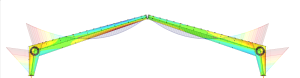
I would highlight the figure below, which was created by overlaying a beam-element model and a shell-element model. I also included it in my diploma thesis as an interesting illustration. It shows how tensile and compressive stresses develop in a shell model of a three-hinged frame, and how these are reflected in the bending moment diagram of a beam model.
9. What did you learn from the design and analysis process that will influence your future engineering work?
I learned the most about the design of connections and joint details. Much greater attention had to be paid to how the interactions within a joint influence one another. For example, what effects can arise from an improperly designed connection, and how such problems can be resolved. Throughout the project, my supervisors provided continuous support, and I would like to take this opportunity to sincerely thank them for their work.